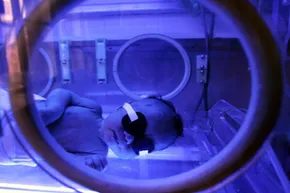
You have probably seen the photos. A tiny newborn lies under a bright blue light, wearing those little protective eye shields. It looks like a miniature tanning session gone wrong, or some kind of sci-fi sci-fi procedure. But those beams are actually a medical lifeline. They are called bili lights, and they are the standard, life-saving treatment for newborn jaundice.
If your baby is under those lights, you might feel confused or worried. You are not alone. Understanding what is happening, why it happens, and how the treatment works can take the edge off the fear.
The Yellow Warning Sign
Newborn jaundice, medically known as hyperbilirubinemia, is incredibly common. It affects more than half of all full-term babies. The condition happens because a newborn’s liver is still maturing. It isn’t quite ready to handle the job of breaking down old red blood cells.
Before birth, the mother’s liver and the placenta did this work. After birth, the baby has to take over. Sometimes, that system gets backed up. Red blood cells break down and release a substance called bilirubin. When bilirubin builds up in the body’s tissues, it turns the baby’s skin and the whites of their eyes a distinct yellowish hue.
This is not just a cosmetic issue. If left untreated, high bilirubin levels can cross into the brain. This can lead to serious, permanent complications like brain damage, cerebral palsy, or hearing loss. That is why doctors watch for it so closely.
How the Blue Light Works
Bili lights are a form of phototherapy. They are not magic, they are physics. The lights, which can be fluorescent bulbs or modern LEDs, emit a very specific spectrum of light. Specifically, they produce wavelengths between 420 and 470 nanometers. This range is what gives the light its intense blue color.
When this blue light penetrates the infant’s skin, it changes the structure of the bilirubin molecules. It turns the bilirubin into a water-soluble form. This is key. The body can then easily eliminate the processed bilirubin through urine and stool without the liver having to do all the heavy lifting.
What Happens During Treatment
Treatment is usually straightforward but requires attention to detail. The goal is maximum skin exposure.
- Skin Contact: Babies are not swaddled in blankets during phototherapy. The more skin exposed to the light, the faster the bilirubin breaks down.
- Rotation: Nurses or parents turn the baby regularly. This ensures all areas of the body, including the back, get equal exposure.
- Eye Protection: The tiny shields cover the eyes. The intense light can be irritating to the retina, so protection is mandatory.
- Hydration: Phototherapy can increase fluid loss, leading to dehydration. Staff monitor vital signs closely. Some babies receive extra fluids intravenously if needed.
Most babies spend 24 to 48 hours under the bili lights. Once the bilirubin levels drop to a safe range, the treatment stops. The baby’s liver has usually caught up by then and can handle the bilirubin on its own.
What If the Lights Don’t Work?
In rare cases, bili light therapy may not lower bilirubin levels fast enough. If the levels remain dangerously high, doctors may recommend a blood exchange transfusion. This is a more invasive procedure where the infant’s blood is slowly drained and replaced with donor blood or plasma. It is a last-resort measure but highly effective.
Why Don’t Adults Use Bili Lights?
You might wonder if adults with jaundice can use these lights too. The answer is generally no. The reason lies in the cause.
In newborns, jaundice is often a temporary growing pain. The liver is just slow to start. In adults, jaundice is rarely a temporary developmental phase. It is usually a symptom of an underlying issue, such as liver disease, hepatitis, or a blocked bile duct. Treating adult jaundice requires diagnosing and fixing the root cause. Blue light alone cannot fix a blocked duct or a failing liver.
Managing Jaundice at Home
While severe cases require hospitalization, mild jaundice is often managed differently. Many pediatricians and midwives suggest a few home strategies for mild cases:
- Indirect Sunlight: Placing the baby near a well-lit window for 10 to 15 minutes, four times a day, can help. Do not put the baby in direct sunlight.
- Frequent Feeding: Ensuring the baby feeds often helps flush bilirubin through stool.
- Medical Consultation: Always speak with your healthcare provider. They will determine if home care is safe or if hospital treatment is necessary.
Comfort and Care
Being under the lights can be stressful for a newborn. The bright environment is unfamiliar, and the lack of swaddling can feel unsettling. How can you help your baby settle?
- Skin-to-Skin: If the hospital allows, ask about a bili blanket. This is a fiber-optic blanket that wraps around the baby, allowing you to hold your child in your arms while they receive treatment.
- Voice and Touch: Stay close. Stroke your baby’s hand. Talk softly. Your presence is calming.
- Patience: Some babies fuss more under the lights. This is normal. It usually passes once the bilirubin levels drop.
Is phototherapy painful? No. It is safe, effective, and generally not uncomfortable for the baby. The main side effects are minor, like loose stools or slight dehydration, which are easily managed.
The Bottom Line
Bili lights are a simple, brilliant solution to a complex biological problem. They buy time for the newborn’s liver to mature. They prevent catastrophic outcomes. And they allow babies to return to normal life quickly.
If your baby needs this treatment, trust the process. It is temporary. It is safe. And it is working.
For more on newborn health, you might also look into topics like seborrheic dermatitis in infants, safe practices for tanning during pregnancy, or how to choose the right sunscreen for babies. Understanding these topics helps build a broader picture of infant care, reducing anxiety and empowering parents with knowledge.
Sources:
– Williams, Mike. “Kitchen serves up blue-light special.” Rice University, April 30, 2009.
– Medline Plus. “Newborn Jaundice.” National Institutes of Health.