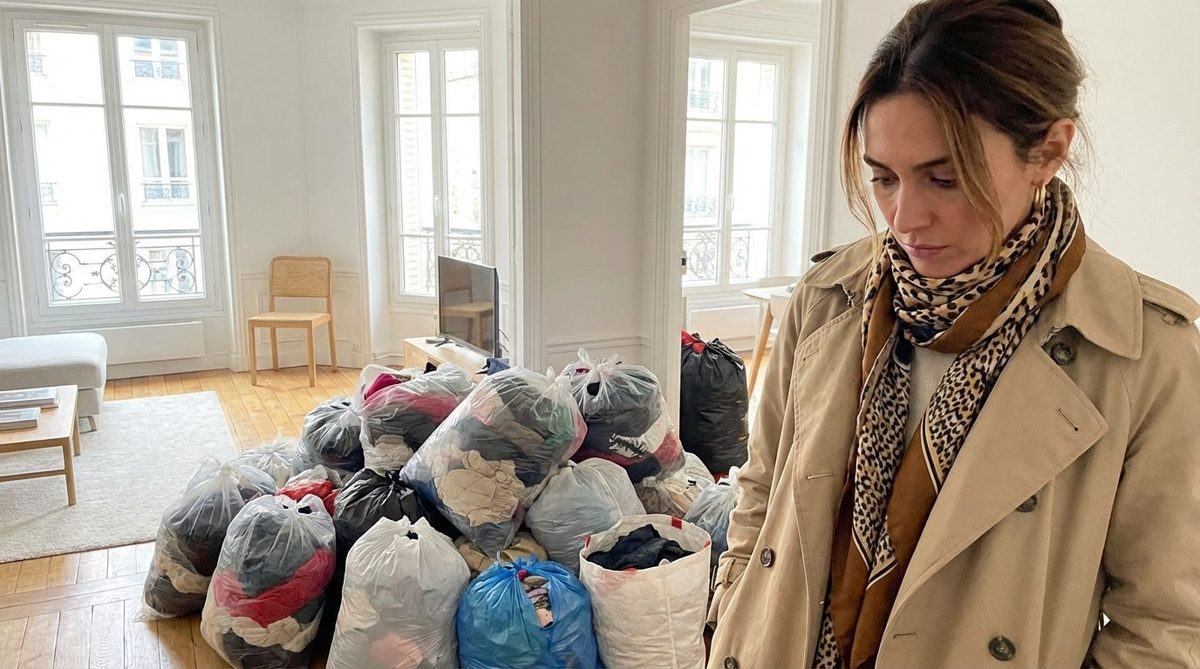
March 2026. The buds are showing. The windows are flung open. It is that time of year again: the spring cleaning ritual. You drag the overflowing bags to the curb. You feel good. You have saved money on dry cleaning, you feel virtuous about the circular economy, and you have absolved yourself of that impulse buy during the January sales.
It feels like a win.
It is not.
Those mountains of textiles are not saving the world. They are suffocating the recycling infrastructure designed to handle them. The system is near collapse. And your old acrylic sweater? It is part of the problem.
When Generosity Overwhelms Sorting Centers
The intention is noble. The logistics are a nightmare.
Walk down any street in France. You see the collection bins. They look like vessels of hope. They are actually monuments to unmanageable overconsumption.
Since a few years ago, the volume of discarded clothing has exploded. We renew wardrobes at breakneck speed. We toss the old to make room for the new. The collection structures were not built for this tidal wave. They are drowning.
The warehouses are full. Literally. Piles of colorful textiles reach near the ceilings. Sorters do not have the manpower or the technical capacity to process this flood.
We Are Treating Bins Like Magic Pits
Let’s be honest about the quality of what we donate. It is often poor.
Too many people treat collection bins like landfills. Stained clothes. Torn garments. Damp or even moldy items. One wet piece in a closed bag can spoil an entire load. It renders the whole lot unrecyclable.
This is “wish-cycling.” The belief that your trash will miraculously be saved. It wastes time. Sorters spend precious hours manually separating items that should have gone in the black bin from the start.
The Export Myth Is Dead
For decades, the model worked like this: Unsold items in French charity shops went to live a second life in the sun.
That myth is dead.
African and Asian Markets Are Shutting Down
Countries that used to accept our bales of used clothes are saying stop. West Africa and Southeast Asia are saturated.
They do not want our disguised waste. It is strangling their own artisanal textile industries. This historical outlet is drying up. Containers that used to sail away without issue are now stuck. There are no buyers willing to pay for our old textiles.
Global Competition Is Cruel
France is not alone in wanting to shed its old clothes. We are in direct competition with the rest of the Western world.
Especially the US and China. They flood the second-hand market with colossal volumes. Foreign importers have become picky. They demand higher quality and lower prices.
Our old clothes, sorted with expensive European labor costs, cannot compete with cheaper bales from elsewhere. Our stock piles up. The industry clogs up.
Fast Fashion Quality Is Sabotaging Recycling
This is the core issue. It makes anyone who cares about fabric quality grind their teeth.
The drop in clothing quality has turned textile gold into lead.
Synthetic Fibers Ruin Everything
Check the label on your last cheap purchase. Polyester. Acrylic. Spandex.
These petroleum derivatives have taken over our closets. They age terribly. After a few washes, they pill. They stretch out. They lose shape.
A nice wool coat or denim jacket can last decades. A fast fashion top is often at the end of its life before it even hits the bin. You cannot resell it in a charity shop. No one wants a garment worn to the bone.
The Paradox of Sorting
It is a cruel equation for recyclers.
They process larger and larger volumes. They find fewer and fewer quality pieces to resell at a good price. These sales fund the rest of the chain.
The proportion of reusable textiles is collapsing. Most items are now low quality. They can only be used for insulation or wiping rags. Those outlets pay pennies. The sorting costs euros.
We are feeding a machine that is designed to process value, not waste. And we are feeding it trash.
The Math Isn’t Adding Up: How Fast Fashion is Breaking the Charity Model
If you look at the numbers, the situation is red. The economic model that has allowed charities to survive on clothing donations is broken. It is not just a dip. It is a structural collapse.
Operational Costs Are Exploding
Running trucks to empty bins. Heating sorting centers. Paying wages for insertion employees. Every step costs more. Inflation has hit this sector hard. It is logistics-heavy. It is labor-intensive. Costs have skyrocketed. Meanwhile, the value of the raw material is plummeting.
The old system of cross-subsidization no longer works.
The Historic Model Can No Longer Self-Fund
Previously, selling high-quality pieces and exporting them covered the costs of sorting less desirable clothes. That system of communicating vessels is broken. Used clothing collection in France is at its breaking point. Costs are rising faster than revenue. Subsidies and eco-contributions from brands are not enough to fill the gap. It is a financial freefall.
The Industry is Gasping for Air
We cannot pretend otherwise. Without major intervention, the entire system of solidarity and textile recycling risks collapsing. This is not about minor adjustments. It is about survival.
The Warning Shots from Major Players
Major players in solidarity collection are sounding the alarm. Several historical structures face bankruptcy. If they close, thousands of local jobs vanish. These jobs are often for people in difficulty. More importantly, who will take our tons of clothes? Illegal dumping could become the norm if the official sector implodes.
The Need for a Complete Overhaul
Small fixes will not work. Actors want a reform that rethinks the economic model. They need more aid for sorting. They want stricter taxation on fast fashion to fund its own end-of-life under the polluter-pays principle. They need new local industrial outlets to recycle textile fibers in France. Turning old sweaters into new yarn is promising. It requires colossal investments the sector cannot bear alone.
Rethinking Consumption Before We Throw It Away
The best waste is the one we do not produce. Breaking this vicious cycle requires a change in our own habits.
Accepting That Recycling Cannot Absorb Our Overconsumption
We must break the myth of infinite recycling. No, your single-worn dress will likely not become a new dress. It might end up incinerated. Or as low-grade insulation. Realizing this should make us slow down. Dropping a garment in a bin should not absolve our buying frenzy.
Towards New Responsibility: Buy Less, Wear Longer, Dispose Better
The trend in spring 2026 is a return to common sense. Prioritize timeless pieces and natural materials like linen or wool. They repair and recycle better. Learn to sew a button. Put on a patch. Turn torn jeans into shorts for summer. Before donating, ask if someone in your circle can use it. Or if it deserves to be sold on a second-hand platform. Give value back to what we wear.
Ultimately, the most ecological gesture is not sorting well. It is choosing wisely from the start. Looking at our closets with lucidity, we realize that sobriety might be the most elegant form of fashion. And you, which forgotten piece will you decide to save and wear proudly this season instead of abandoning it?