


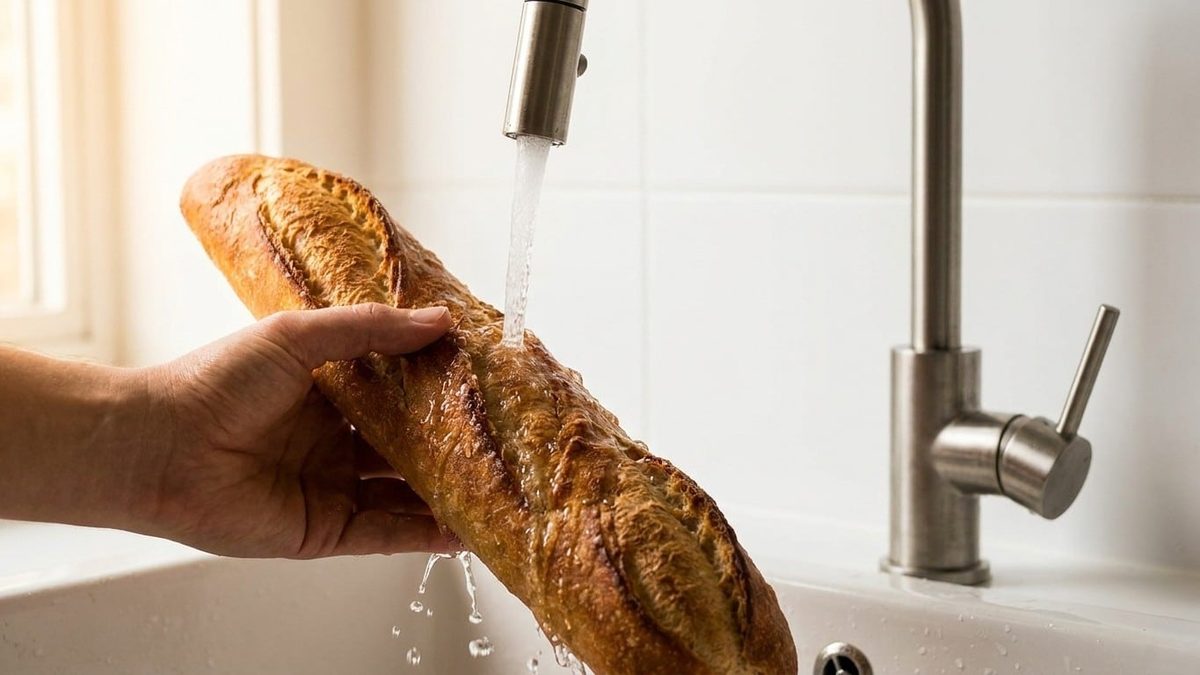
It all started a few years ago with a random comment from a local baker. He barely looked up and said, “Yesterday’s baguette? Put it in water, put it in the oven and wait 10 minutes.”
A random piece of advice I gave to a customer at a local bakery changed the way I cook. Since then, I have never thrown bread in the trash.
This is not just a personal quirk. This is a massive cultural leak. 61 percent of French people admit that they sometimes throw bread. 41% of them throw away more than half of their bread per month. This is equivalent to 6 baguettes thrown away per person per year. In France, bread is, along with fruit, the most wasteful food, before vegetables. 6 loaves seems small. Multiply that by 68 million people and that’s a lot of wasted flour, water and labor.
Here’s the truth about stale bread and exactly how to bring it back to life.
The science of stale bread
What really happens inside the hardened bread? It’s not spoilage. Bread is not “bad”. It’s just a simply dehydrated.
As the starch in the crumb cools, it goes through a process called crystallization. This changes the internal structure, making the crumb harder and less elastic. Loss of moisture results in a tough, flavorless texture. However, this is a physical change, not a chemical breakdown. Physics can be reversed.
Baguettes are the worst offenders of dryness. Why? surface area. About 70% of the volume of the baguette is exposed to the air. Compared to a round boule, its surface area is small compared to its mass. A baguette dries two or three times faster than country bread. This is not a manufacturing defect. This is mechanical. The characteristic shape is crisp and dry.
Reversing the Crystallization
To repair stale bread, starch crystallization must be reversed. This can be achieved by adding moisture again in the form of steam.
When the bread is heated, the water turns into steam. This steam penetrates the breadcrumbs and rehydrates it from the inside. Ovens do more than just heat bread. We are actively restructuring the crumb’s elasticity. Bakeries have used this mechanism for generations. Now you can do it too.
The Exact Method to Revive Stale Bread
The technique is simple. This is a two-step process. If you fail the first step, the entire dish will fail.
- **Wet the crust. ** Remove the day-old baguette. Soak in cold water for a few seconds. Just a little. You need to dampen the crust, not soak the bread. Most people go too far. They think they have to “drown” the bread, and it will be soggy. Turn the baguette upside down and so every side gets a quick rinse. Stop when it is moist to the touch (not saturated).
- **Bake in the oven. ** Preheat the oven to 180°C (350°F). Place the baguette directly on the oven rack. Do not use the baking sheet. The solid tray traps steam and makes the bottom soft. The rack allows air to circulate and keeping the crust crisp.
Bake for 5-10 minutes. The time varies depending on the hardness and size of the bread. You want a hot interior and a crust that cracks when you bite into it.
Limits and Best Practices
This tip is good for breads that are stale, ranging from a few hours to a couple of days. Beyond that, the dehydration goes too deep. The crumb may not completely regain its original softness.
If the baguette is very hard, first cut it into small pieces. Smaller pieces moisturize more evenly and heat up faster.
One final warning. This second life is temporary. The revived texture lasts about 2-3 hours at room temperature. After that, the moisture escapes again. Eat fresh or toast it. But don’t let it sit.
The result is warm, crackling loaf that tastes like it came out of the oven 5 minutes ago. No waste. No guilt. Just better bread.
Why consider stale bread trash when it’s just waiting to a little steam? The answer could change the way you shop for groceries. And how you feel about food in the trash?
Storage techniques for stale bread are disappearing
It wasn’t always this way. For generations, bakers have used this technique to turn yesterday’s unsold bread into tomorrow’s gold. That stale bread didn’t disappear into the trash. It went back into the oven before the doors opened or becomes the base for something new.
The relationship with bread has shifted. In France, 10 billion baguettes are sold annually. Over 300 in seconds. Over 27 million daily. At this industrial scale, the baguettes are disposable. It is no longer a product to be kept.
Let’s see where the waste actually comes from. 68% of people throw bread in the trash. simply because it has gone dry or hard. The reality? Only 59% of people freeze extra food, and 36% reuse it in recipes such as pain perdu (French toast) and breadcrumbs. We leave value on the table.
Why Freeze is a game changer
If you buy more homemade bread, don’t leave it unused. Freeze the portions you won’t eat immediately. It keeps it fresh. Locks in the flavor.
The water oven method is perfect for serving slices right out of the freezer when you’re ready to eat. The ice crystals turn to steam instantly. The crust crisps. The inside remains soft. This is a simple solution to a big problem.
Hidden water costs in waste
Throwing away one baguette wastes 150 liters of water. This number is not arbitrary. It is directly related to the cultivation of wheat. Consider the context. Water resources are under strain.
150 liters corresponds to a 28-minute shower. All for one loaf of bread. This stat alone should be enough to break this habit. If not, look deeper.
Fermentation, like natural sourdough (levain naturel ), can improve the sensory quality of bread. Stays fresh for a long time. It tastes better. Compared to commercial bread, no waste is naturally generated. Choose wisely. Eat well. Save what you can.

