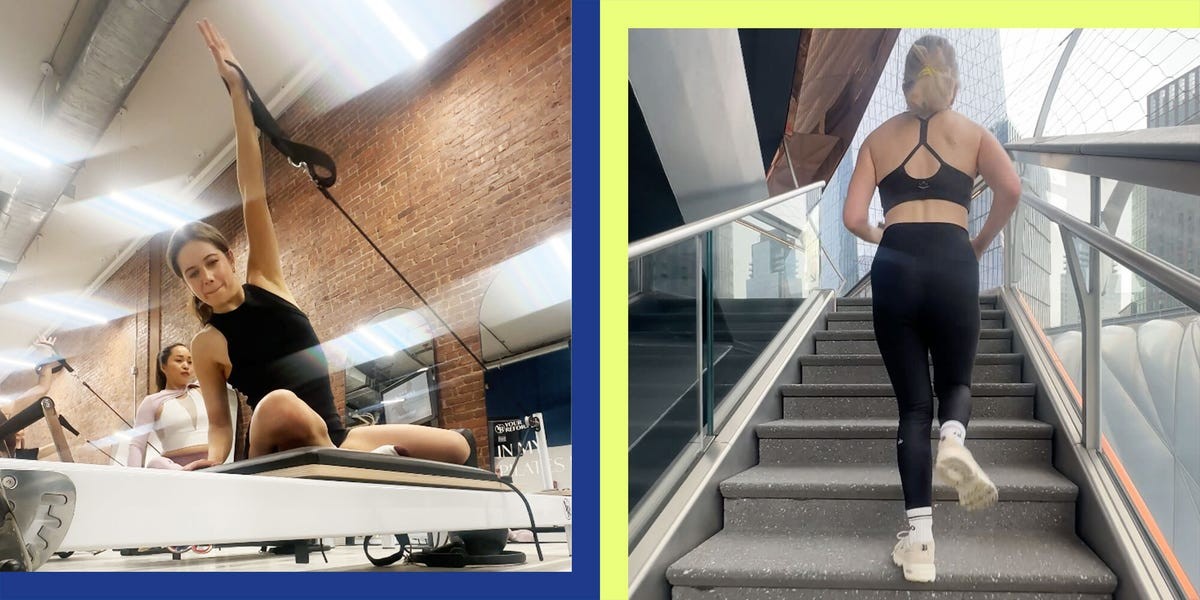
My feed was flooded last year with the great fitness civil war: Pilates vs. Weightlifting. One side swore that switching to reformers gave them the lean look they’d chased for years. The other side claimed heavy iron was the only way to sculpt. My algorithm eventually settled on a compromise.
Now I keep seeing videos about the 3-2-1 workout method.
It’s simple. Three days of strength. Two days of Pilates. One day of cardio. One day off. The concept comes from Courteney Fisher, a certified trainer and founder of Fit with Coco. She developed the split after realizing that HIIT was leaving her fried. More Pilates and strength work? Her energy went up. Inflammation went down. She got leaner.
Naturally, I had to test it.
As a new Pilates instructor, I’m already hooked on the mat work. But my usual routine is three to four days of pure weightlifting with random classes thrown in. So I challenged myself to stick to that strength frequency while forcing Pilates and cardio into the mix.
Here is the raw look at how I programmed it over 30 days, where I stumbled, and whether the hype holds up.
How the 3-2-1 Structure Actually Works
You can shuffle the days however you want. The math is rigid, but the schedule isn’t. Just hit three strength sessions, two Pilates blocks, and one cardio blast. Fisher emphasizes one non-negotiable rule: progressive overload. You have to increase intensity over time or you plateau. Period.
I didn’t just wing it. I built a four-week grid. Some weeks flowed. Week four was a logistical nightmare.
Week 1: The Honeymoon Phase
- Day 1: Mat Pilates
- Day 2: Lower Body Strength
- Day 3: Outdoor Run (Cardio)
- Day 4: Lower Body Strength
- Day 5: Reformer Pilates
- Day 6: Full Body Strength
- Day 7: Rest
Week 2: The Slump Begins
- Day 1: Rest
- Day 2: Orangetheory Class (Cardio)
- Day 3: Upper Body Strength
- Day 4: Lower Body Strength
- Day 5: Mat Pilates
- Day 6: Lower Body Strength
- Day 7: Mat Pilates
Week 3: Recovery and Confusion
- Day 1: Rest
- Day 2: Lower Body Strength
- Day 3: Equinox Run Class (Cardio)
- Day 4: Lower Body Strength
- Day 5: Lower Body Strength
- Day 6: Reformer Pilates + Rumble Training
- Day 7: Reformer Pilates
Week 4: The Chaos Week
- Day 1: Kinesis Class (Cardio)
- Day 2: Yoga
- Day 3: Upper Body Strength + Pickleball + HIIT Class
- Day 4: Lower Body Strength
- Day 5: Reformer Pilates
- Day 6: Lower Body Strength
- Day 7: Reformer Pilates
I had to plan a full week ahead every Sunday. Back-to-back lifting on the same muscle group? Forbidden. I avoided it. Some weeks were easy. Week four? A mess. I was on a work trip with a packed schedule of non-strength classes. I ended up doing nine workouts to force the square peg into the round hole. That wasn’t Fisher’s vision. That was my problem.
I felt energized mentally, even if my body was starting to rebel.
The Physical Reality: What Changed
In Week 1, everything clicked. I was smart about it. I lifted at the gym in my building’s weight room right out of bed. I rented a reformer for my apartment so I could stream workouts without leaving the couch. It was efficient. I felt great. Not sore. Not burnt out. Just… lighter.
Did I see abs? Not in seven days. Obviously.
Week 2 hit me like a truck. I was rundown. My body screamed for a break. Instead of resting, I lowered the intensity. Lighter weights. Gentle YouTube Pilates. It was a compromise that barely counted as recovery.
By Week 3 and 4, I bounced back physically, but the mental toll of scheduling remained. And yet, the benefits were real.
I’m naturally flexible, but Pilates made me supple. The constant tightening from heavy squats and deadlifts? Gone. Replaced by a feeling of loose, long muscle fibers. And yes, my abs looked sharper. I’ve tried every core trick in the book. Reformer Pilates is the only thing that actually engages them effectively for me.
Then there was the cardio. I ran longer. Less winded. That wasn’t magic. It was just consistency. Two days of dedicated cardio a week does what sporadic HIIT never did: it built my aerobic base without wrecking my CNS.
3 Takeaways from the 30-Day Challenge
1. Convenience is Everything
If you have to commute to a Pilates studio and a commercial gym, this schedule collapses under its own weight. Time kills passion.
I did most of it at home. If I hadn’t, I’d have quit by Day 10. If I tried this again, I’d make it easier. Short sessions. Home-based cardio (bike instead of driving to the gym). But I wouldn’t stick to it forever. It’s too rigid for long-term adherence. Use it as a tool, not a life sentence.
2. I Crave Flexibility
This method boxed me in. And I’m fine with coasting sometimes. I don’t need a perfectly optimized regimen every single week. Some weeks I need cardio. Some weeks I just want to lift. Some weeks I need rest that isn’t scheduled—it’s earned by fatigue.
The 3-2-1 workout removes the ability to listen to your body in real-time. It demands you follow the calendar, not your muscles. If you’re type-A and love crossing things off a list, this is your paradise. If you like fluidity, you’ll feel suffocated.
3. Variety Still Matters
I’m not keeping the strict schedule. But I am keeping the ingredients.
I want more Pilates for the flexibility and core engagement I couldn’t find in the rack. I want more steady-state cardio for heart health, even if I don’t love it. The method was too sterile. The components are valuable.
Should You Try the 3-2-1 Method?
It works if you have the time. It works if you have the discipline. It works best if you’re already active—jumping from zero to six days a week is a recipe for injury.
It’s a solid blueprint for balance. Three strength days keep you strong. Two Pilates days keep you mobile. One cardio day keeps your heart healthy. One rest day… actually lets you rest.
I finished the month depleted but accomplished. I learned what works for my body and what doesn’t. The best routine isn’t the most popular one on TikTok. It’s the one you can stick with when the novelty fades.
If 3-2-1 fits your life? Try it. If it feels like homework, don’t. You’ll find something better.